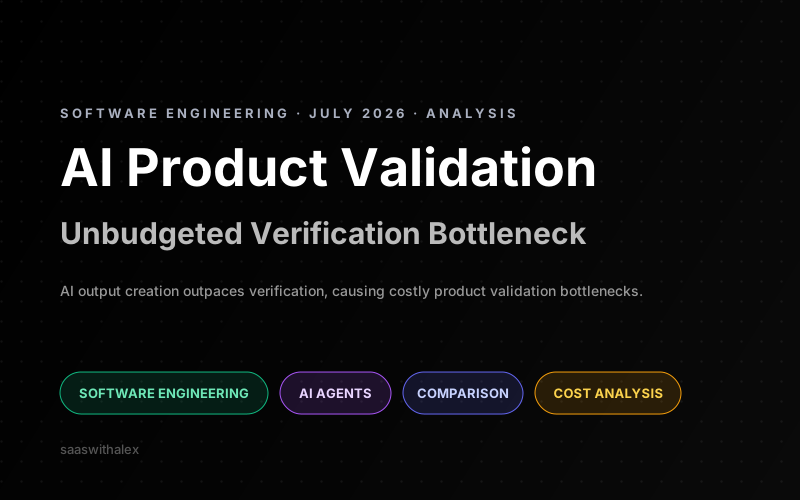
Over half of enterprises ship critical defects from unverified AI-generated code, as verification processes haven't kept pace with exponential AI creation speed. This validation velocity mismatch is the central failure pattern in AI product validation, driving costly production incidents and lost customer trust. Teams must prioritize verification infrastructure over raw AI output speed to reduce risk.
Tag: software engineering
135 posts tagged with "software engineering" — Page 3 of 6
OpenAI's shared agent credit pool and reduced Codex context window create unique cost and productivity challenges for Django development teams. The framework's dense, interdependent codebase fills context faster than leaner alternatives, and cross-departmental credit competition often cannibalizes high-value engineering work. Proper model routing and departmental budget guardrails are required to control total cost of ownership.
Seventy-one percent of news publishers accidentally block AI search crawlers via robots.txt, making their sites invisible to ChatGPT answers. Blanket 'block AI bots' rules often catch the wrong crawlers, as AI vendors split training and search agents most site owners don't know exist. Explicitly allowing search crawlers in your robots.txt restores AI visibility without sacrificing content licensing control.
AI adoption is surging across enterprises, but traditional API gateways were never designed for token-metered, streaming-heavy LLM traffic. This post breaks down the core mismatch between request-based API gateways and token-native AI gateways, covering pricing, performance, and ideal use cases for engineering teams.
Most enterprises rely on 2019-era SaaS RFP templates for AI procurement, which systematically miss critical risks including probabilistic outputs and shifting compliance rules. These outdated templates lead to six- and seven-figure bad deals, but ground truth procurement frameworks that test vendors on your actual data and workloads eliminate those gaps.
In 2026, leading AI coding assistants for Python all run the same underlying Claude models, making the workflow shell (editor, terminal, browser) the real differentiator rather than AI intelligence. Actual per-developer costs with agentic workflows hit $200–$600 monthly, far above advertised seat prices, while median teams only see a 7.76% PR throughput gain.
TypeScript's 2026 growth made it a first-class target for AI coding tools, but tooling fragmentation and low developer trust mean single-vendor stacks carry hidden risk. The best approach for most teams is combining 2-3 specialized agents matched to their workflow, codebase maturity, and governance needs.
This 2026 comparison of Cursor and Claude Code for Go development finds that tool choice depends on workflow type, not raw syntax capability. Claude Code is more token-efficient for complex multi-file refactors common in Go monorepos, while Cursor delivers faster, lower-cost performance for small contained edits.
This post introduces the Tacit Tax: the hidden, often massive cost of converting engineering teams' tacit tribal knowledge into AI-usable formats, which dwarfs per-seat AI software license fees. It uses real-world case studies and pricing analysis to show that per-seat pricing models misalign vendor incentives with actual AI adoption success, and offers a decision framework for engineering teams evaluating AI knowledge transfer tools.
LLM referral analytics shows a stark divide: massive crawler traffic yields almost no referrals, while the few AI-referred visitors convert at 11x the rate of search. Most analytics tools miss this traffic, labeling it as direct, so teams optimize the wrong layer and overlook the highest-converting source.