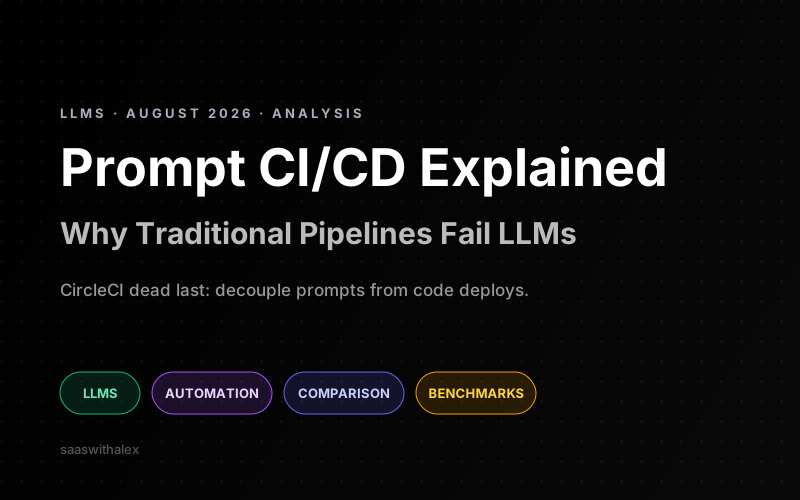
You should decouple prompt updates from code deploys because traditional CI fails LLM applications: prompts change faster than binaries and fail silently. 70% of teams update prompts monthly and 10% daily, yet CircleCI finished dead last at 13 minutes 18 seconds versus Semaphore's 5 minutes 1 second, proving speed branding is decoupled from runtime reality.
Tag: automation
21 posts tagged with "automation"
This guide exposes the hidden costs of AI subscription sprawl for early-stage founders, including the 'sovereignty recoil pattern' where initial tool convenience turns into expensive scaling debt. It outlines a minimal '1+2 model' AI stack and compares self-hosted vs SaaS automation, coding, and app builder tools to avoid costly retrofits.
Production Kubernetes clusters suffer catastrophic underutilization, with average GPU utilization at just 5% and CPU overprovisioning up 69% year over year. The emerging Autonomous Stack pattern uses AI agents to continuously rightsize, bin-pack, and reallocate resources in real time, cutting cloud spend by 50–75% for AI workloads.
DevOps teams lose 23% of sprint capacity to toolchain fragmentation, and ungoverned AI tools risk adding cost and compliance overhead instead of reducing toil. This guide compares the best free AI DevOps tools across CI/CD, observability, and workflow automation, highlighting options with transparent cost governance and native workflow integration.
94% of companies deploying AI see no significant value from their investments, per McKinsey research, due to unplanned glue work stitching siloed tools together. Pre-Series A SaaS founders should cap their AI stack at six core tools, each replacing at least three manual workflows or point solutions to avoid workflow compression failure.
Postman's 2026 free tier limits teams to 1 user and 50 monthly AI credits, making it unusable for collaborative projects. Most 'free' AI API testing tools gate critical team governance, CI/CD integration, and unlimited scale features behind expensive paid tiers, creating hidden adoption ceilings for production use.
MCP cuts initial integration costs by up to 85% and shrinks deployment timelines from 11 months to 6 weeks for mid-market teams. But savings invert at scale as token burn and required governance infrastructure erase early gains, making hybrid REST and MCP architectures the pragmatic production standard.
The default GitHub MCP server authentication model is built for individual developers, not enterprise multi-agent deployments. This guide explains how to configure local GitHub App token authentication to enable dynamic per-workflow identity, avoid Copilot license requirements, and support GitHub Enterprise Cloud. You'll learn step-by-step setup, security best practices, and governance patterns for production use.
The official GitHub MCP server adds up to 42,000 tokens of schema overhead per agent call, consuming 21% of a 200K context window before any real work begins. For production and multi-tenant B2B workloads, a thin REST API adapter with GitHub App authentication eliminates this tax, provides higher rate limits, and removes mandatory Copilot license dependencies.
Notion's official hosted MCP server offers seamless AI workspace integration but has major capability gaps compared to its deprecated local counterpart, plus hidden costs tied to Notion plan tiers. Engineering and enterprise teams must evaluate these tradeoffs carefully before adopting the integration for production use.