Blog
Page 13 of 19
Over 60,000 repositories now ship AGENTS.md files, but research shows poorly written ones reduce task success rates and increase inference costs by over 20%. The key mistake is treating AGENTS.md as documentation rather than operational policy—auto-generated files and those exceeding 100 lines cause significant performance degradation. Human-written, minimal files under 100 lines improve performance by 2-6% when they focus on command-first behavioral rules.
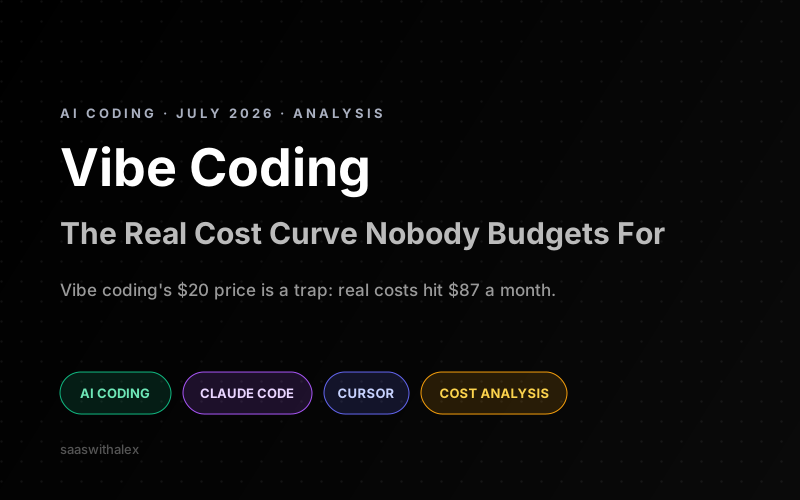
Five major AI coding tools now charge $20 per month, but their real costs diverge dramatically based on usage patterns. Terminal-native agents like Claude Code differ fundamentally from cloud-based tools in both workflow and billing structure, making the sticker price nearly meaningless for serious users.
AGENTS.md is an open-source Markdown standard for providing AI coding agents with project-specific instructions, now supported by 28+ tools and adopted in over 60,000 repositories. Research shows that minimal, constraint-focused AGENTS.md files deliver better agent performance, lower inference costs, and fewer failures than bloated, overly detailed versions.
Most root-level AGENTS.md files deliver negligible or negative returns for AI coding tools, per 2026 ETH Zurich research. Curated minimal files with only non-inferable rules cut task time by 28% and reduce agent-generated bugs by 35-55%. Avoid bloat, redundant overviews, and stale content to boost performance and lower inference costs.
AGENTS.md is a plain Markdown file that gives AI coding agents project-specific operational guidance, from build commands to coding conventions. Human-curated files deliver a 35-55% reduction in agent-generated bugs, while auto-generated or bloated files add hidden token costs and hurt reliability. This guide covers real-world adoption patterns, cost tradeoffs, and a minimal template to get started.
A February 2026 arXiv study found that AGENTS.md context files reduce AI coding agent task success rates while raising inference costs by more than 20%. Claude Code's native memory systems offer more advanced features but suffer from broken subagent context inheritance and fragile prompt caching, leaving both approaches unable to solve the persistent context problem for development workflows.
AGENTS.md has emerged as a near-universal standard for AI coding tool configuration, but GitHub Copilot only treats it as suggestive context rather than enforceable rules. This enforcement gap creates unexpected policy gaps and rising costs for teams relying on the file to enforce coding guardrails in Copilot workflows.
This post compares AGENTS.md, the open cross-tool agent configuration standard, and Cursor's proprietary .cursor/rules/*.mdc format for project rules. It breaks down feature tradeoffs, instruction budget impacts, and cost implications, recommending a layered architecture with AGENTS.md as the canonical source of truth paired with thin tool-specific adapter files.
This guide compares four proven AGENTS.md template patterns for 2026, covering routing tables, memory persistence, identity decomposition, and domain-specific guardrails. We break down each template's ideal use case, key tradeoffs, and which pattern offers the best balance of portability and low overhead for most engineering teams.
Anthropic's Model Context Protocol (MCP) has seen widespread enterprise adoption but ships without mandatory authentication, built-in access controls, or audit logging. This architectural gap creates critical security risks including tool poisoning, path traversal vulnerabilities, and ungoverned credential sprawl. Teams must implement gateway-based governance and description pinning to mitigate these threats.
MCP cuts initial integration costs by up to 85% and shrinks deployment timelines from 11 months to 6 weeks for mid-market teams. But savings invert at scale as token burn and required governance infrastructure erase early gains, making hybrid REST and MCP architectures the pragmatic production standard.
OpenAI's GPT-5.6 launch restricts frontier model access to a small group of U.S. government-vetted 'trusted partners' under a new dual-track release system. This structure creates a hard barrier for the open source community, blocking independent research, transparent benchmarking, and competitive development of open source AI alternatives.
The July 2026 Model Context Protocol specification removes protocol-level session state and the initialize handshake to enable stateless HTTP operation and simple round-robin load balancing. While this cuts infrastructure complexity, it shifts security, state management, and input validation responsibilities to application code, creating new risks for teams without dedicated MCP security engineering expertise.
The July 2026 Model Context Protocol (MCP) stateless specification removes core session and handshake features, requiring unplanned migration work for most existing remote MCP deployments. While it simplifies horizontal scaling, it shifts security responsibilities to development teams and introduces new attack surfaces, with total migration and operational costs often matching or exceeding self-hosted expenses for mid-market teams.